
How people feel and think at work?
Businesses invest heavily in technology, office design, and wellbeing programmes; yet one of the most practical, evidence-supported tools for improving how people feel and think at work is often treated as optional: ART.
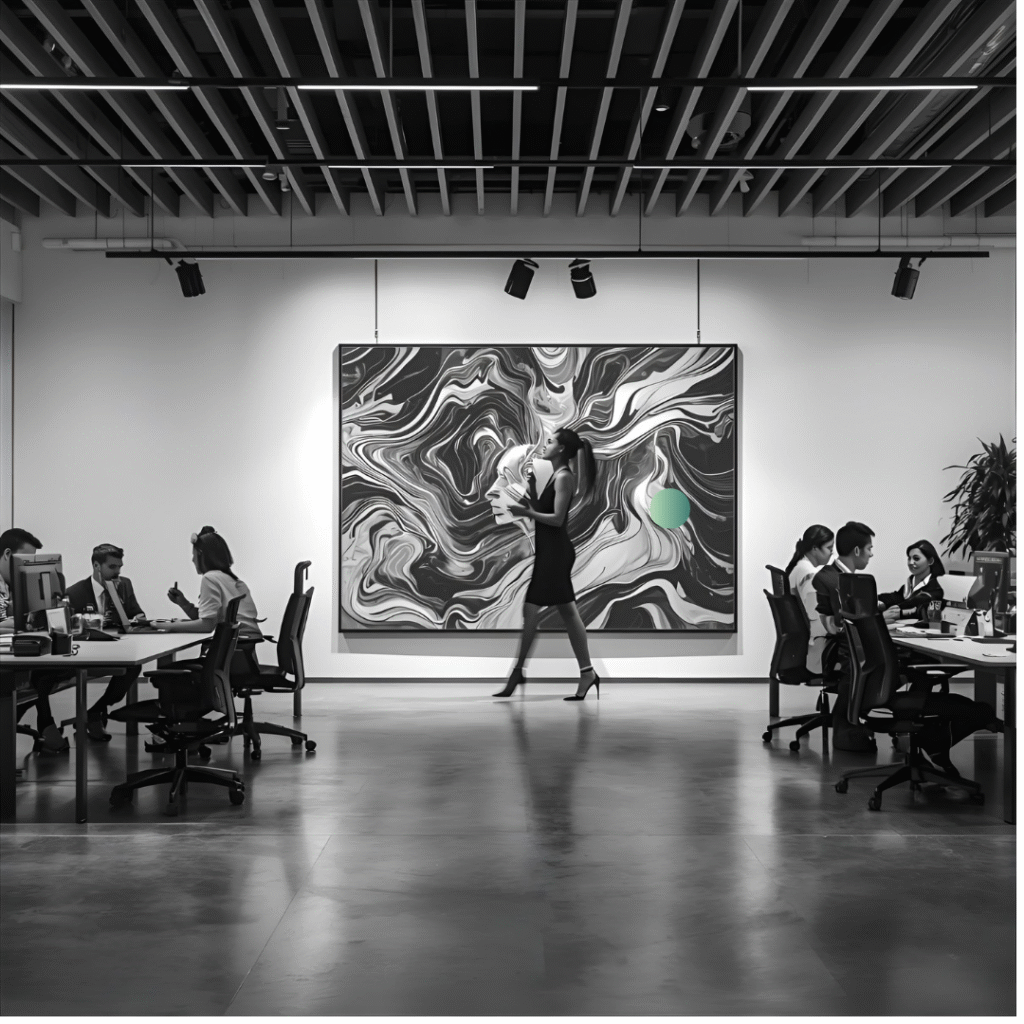
Art in business spaces is not simply decoration. When thoughtfully curated and integrated into the environment, it can support recovery from stress, encourage reflective thinking, and strengthen a sense of identity and belonging. In a workplace culture increasingly shaped by cognitive load, hybrid work, and talent expectations, art can operate as a quiet but powerful part of a broader wellbeing and performance strategy.
Why businesses need art now
Work today demands sustained attention, fast decision-making, collaboration across distance, and constant adaptation. These conditions can be energising but also overwhelming.
An effective workplace doesn’t only reduce friction; it actively helps people restore attention, regulate stress, and shift into more flexible modes of thinking. This is where curated aesthetic experience – art and design can contribute.
What the research actually suggests
A 2025 controlled comparative study conducted by researchers at King’s College London examined the physiological effects of viewing original artworks at The Courtauld Gallery, compared with viewing reproductions in a controlled laboratory setting.
Participants in the gallery condition showed a significant reduction in salivary cortisol (about 22%) after the viewing session, alongside reductions in other specific pro-inflammatory markers. Although this kind of research would need more detail and further testing, the direction is compelling: authentic art viewing can produce measurable, stress-related physiological shifts. One of the researchers described the experience as a “cultural workout for the body.” What this means for workplaces: art may help people transition between modes: focused attention when tasks require precision, and reflective space when teams need integration, synthesis, and new ideas.
How art transforms business spaces in practice
Stress recovery and focus
Visual art can function as “micro-restoration”- a brief, low-effort shift that helps people downregulate stress and return to work with greater steadiness. The goal is not distraction; it’s recovery.
Creativity and problem-solving
Art introduces ambiguity, pattern, emotion, and multiple interpretations – exactly the ingredients that help teams escape linear thinking. In innovation cultures, this is not aesthetic “extra”; it is cognitive variety.
Brand identity and trust
A well-curated collection can express a company’s values and story with far more nuance than slogans. Whether the focus is contemporary, local, heritage, or sustainability-led commissioning, art becomes a visible signal of what the organisation stands for.
Talent attraction and retention
Workplaces communicate culture. Art-forward environments can signal curiosity, care, and human-centred leadership—qualities that matter strongly to younger professionals and globally mobile talent.
Long-term value
Unlike many wellbeing interventions that require ongoing facilitation, art provides ambient benefits over years with minimal maintenance, especially when paired with a rotation plan and internal engagement.
From research to reality - how to introduce art into your workplace:
- Plan early
Integrate art into interior, workplace, and brand strategy, rather than treating it as a final styling decision. - Curate for meaning, not just matching colours
Choose works that invite attention and interpretation, and that align with the emotional tone you want the space to hold (calm, bold, reflective, energising). - Prioritise authenticity and quality
Where possible, original works or high-quality limited editions tend to create stronger engagement than generic prints. - Rotate and refresh
Novelty matters: periodic rotation keeps the environment cognitively “alive.” - Engage your people
Invite staff to respond, vote, discuss, or co-curate. Even light participation increases connection and belonging.
ArtNevis Art Advisory: where art meets strategy
At ArtNevis, we help organisations translate aesthetic evidence into practical workplace value; through curated collections, leasing and rotation plans, commissions, and programmes that align art with culture, wellbeing, and identity.
Art is not a luxury. When integrated with intention, it becomes an asset that supports how people feel, think, and collaborate every day.
References:
- King’s College London / The Courtauld (2025) controlled comparative report on physiological effects of viewing original artworks.
- Chatterjee, A. & Vartanian, O. (2014) review of neuroaesthetics (Trends in Cognitive Sciences).
- Vessel and colleagues on default mode network involvement in intense aesthetic experience.